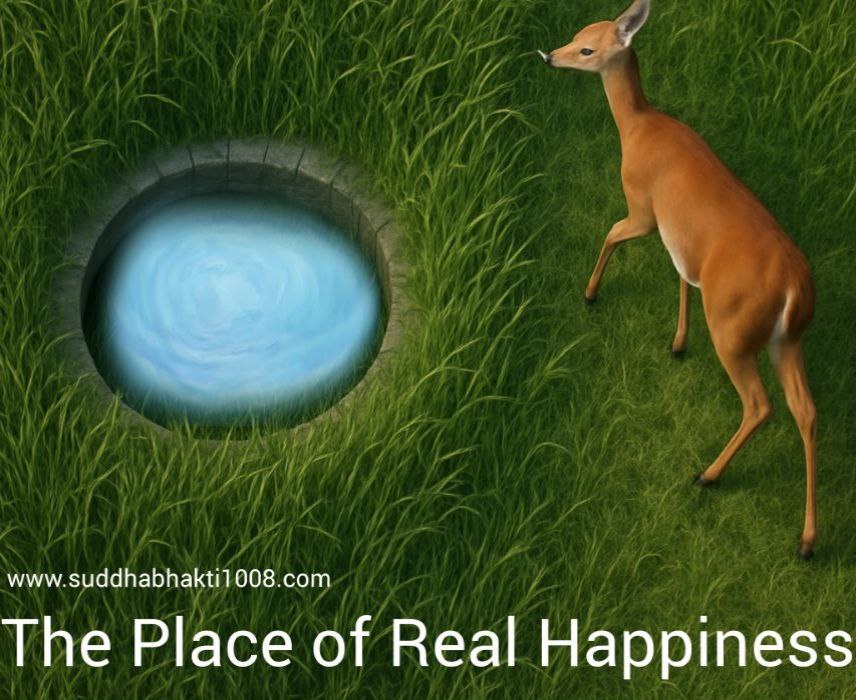
The Place of Real Happiness


Introduction:

This shloka simply explains the state of a human being who, unaware of the happiness within, searches for it in the material world. Just as a deer mistakes a mirage for real water and chases after it, we too search for true happiness in the wrong places, not realizing it resides within us.


The Place of real Happiness

jalaṁ tad-udbhavaiś channaṁ

hitvājño jala-kāmyayā

mṛgatṛṣṇām upādhāvet

tathānyatrārtha-dṛk svataḥ

Synonyms

jalam — water; tat-udbhavaiḥ — by grass grown from that water; channam — covered; hitvā — giving up; ajñaḥ — a foolish animal; jala-kāmyayā — desiring to drink water; mṛgatṛṣṇām — a mirage; upādhāvet — runs after; tathā — similarly; anyatra — somewhere else; artha-dṛk — self-interested; svataḥ — in himself.

Translation

Just as a deer, because of ignorance, cannot see the water within a well covered by grass, but runs after water elsewhere, the living entity covered by the material body does not see the happiness within himself, but runs after happiness in the material world.

Purport

This is an accurate example depicting how the living entity, because of lack of knowledge, runs after happiness outside his own self. When one understands his real identity as a spiritual being, he can understand the supreme spiritual being, Kṛṣṇa, and the real happiness exchanged between Kṛṣṇa and one’s self. It is very interesting to note how this verse points to the body’s growth from the spirit soul. The modern materialistic scientist thinks that life grows from matter, but actually the fact is that matter grows from life. The life, or the spiritual soul, is compared herein to water, from which clumps of matter grow in the form of grass. One who is ignorant of scientific knowledge of the spirit soul does not look inside the body to find happiness in the soul; instead, he goes outside to search for happiness, just as a deer without knowledge of the water beneath the grass goes out to the desert to find water. The Kṛṣṇa consciousness movement is trying to remove the ignorance of misled human beings who are trying to find water outside the jurisdiction of life. Raso vai saḥ. Raso ’ham apsu kaunteya. The taste of water is Kṛṣṇa. To quench one’s thirst, one must taste water by association with Kṛṣṇa. This is the Vedic injunction. 


Conclusion:


We must realize that true happiness lies within us. It is only through devotion to Krishna that one can lead a spiritual life and understand their true identity as an eternal servant of Lord Shri Krishna. When this realization dawns, we can experience genuine happiness—not from the external world, but by discovering our real position as "Krishna’s servant within". A life of continuous service to Krishna is the true path to eternal bliss.


Śrīmad-Bhāgavatam: 7.13.29


By His Divine Grace A. C. Bhaktivedanta Swami Prabhupāda


🔆🔆🔆🔆🔆🔆🔆 🔆🔆🔆🔆🔆🔆🔆 🔆🔆🔆🔆🔆🔆🔆


Hare Krishna Hare Krishna Krishna Krishna Hare Hare

Hare Rama Hare Rama Rama Rama Hare Hare


🔆🔆🔆🔆🔆🔆🔆 🔆🔆🔆🔆🔆🔆🔆 🔆🔆🔆🔆🔆🔆🔆


Hare Krishna 🙏


For Authorized Spiritual Articles,Posters , Quote etc . .  kindly download Telegram application in Google play store and Follow the below link  for telegram Suddha Bhakti channel 👇


https://t.me/suddhabhakti


Comments

Popular posts from this blog

Yogini Ekadasi

  Yudhisthira Maharaj said, "Oh Supreme Lord, I have heard the glories of the Nirjala Ekadasi, which occurs during the light fortnight of the month of Jyeshtha (May - June).  Now I wish to hear from You about the suddha Ekadasi that occurs during the dark fortnight of the month of Ashadha (June - July).  Kindly describe to me all about it in detail, Oh killer of the Madhu demon (Madhusudana)." The Supreme Lord, Sri Krishna, then replied, "Oh king, I shall indeed tell you about the best of all fasting days, the Ekadasi that comes during the dark part of the month of Ashadha. Famous as Yogini Ekadasi, it removes all kinds of sinful reactions and awards supreme liberation. "Oh best of kings, this Ekadasi delivers people who are drowning in the vast ocean of material existence and transports them to the shore of the spiritual world. In all the three worlds, it is the chief of all sacred fasting days. I shall now reveal this truth to you by narrating a history recounted ...

Sri Mukunda Datta

Sri Mukunda Datta was born in the Cattagrama district, in the village of Chanhara, which is under the jurisdiction of the police station named Patiya. This village is situated ten krosas, or about twenty miles, from the home of Pundarika Vidyanidhi. In the Gaura-ganoddesa-dipika (140) it is said: vraje sthitau gayakau yau madhukantha-madhuvratau mukunda-vasudevau tau dattau gauranga-gayakau “In Vraja there were two very nice singers named Madhukantha and Madhuvrata. They appeared in caitanya-lila as Mukunda and Vasudeva Datta, who were singers in the society of Lord Caitanya Mahaprabhu.” When Lord Caitanya was a student, Mukunda Datta was His class friend, and they frequently engaged in logical arguments. Sometimes Lord Caitanya Mahaprabhu would fight with Mukunda Datta, using tricks of logic. This is described in the Caitanya-bhagavata, Adi-lila, Chapters Eleven and Twelve. When Lord Caitanya Mahaprabhu returned from Gaya, Mukunda Datta gave Him pleasure by reciting verses from Srimad...

Hera Panchami

  The Rath Yatra festival is one of the oldest and most popular yatra celebrated in Odisha every year. Devotees throng from far and wide to revere Mahaprabhu Jagannath’s presence amidst them. The devotees walk along the chariot and Rath yatra begins on Asadha Shukla Paksha Dwitiya tithi every year. On this day, Lord Jagannath along with his siblings, Lord Balabhadra and Devi Subhadra along with Sudarshan chakra embark on a nine-day journey to Gundicha Temple which is almost three kilometres from the Shrimandir (Main Temple). They stay there for a week and return to Srimandir on the ninth day. During these nine days, several rituals are performed. Each ritual has its significance. But there is one which portrays an almost human like relationship between Lord Jagannath and his consort Goddess Lakshmi known as ‘Hera Panchami’. This ritual is observed on the fifth day of the Rath Yatra. ‘Hera’ means to search or look for and ‘Panchami’ means fifth. The ritual signifies the longing and ...